Sales Enablement and Client Conversion Improvement Project
An independent portfolio case study based on a real workplace performance challenge, focused on diagnosing inconsistent client conversion and designing the right combination of learning, performance support, workflow, and accountability interventions.
Executive Summary
- Business Problem
- Potential client inquiries did not consistently progress into confirmed training engagements.
- My Role
- Instructional Designer and Performance Consultant
- Approach
- Performance analysis before training design
- Project Type
- Independent anonymized workplace case study
- Timeline
- 10-week portfolio project
- Current Status
- Diagnostic phase completed; Storyline prototype developed; supporting intervention assets remain in development.
What This Case Study Demonstrates
Technologies Used
Project Status
- Diagnostic ToolkitCompleted
- Gap Analysis MatrixCompleted
- Sales Enablement Solution DesignIn development
- Sales Playbook / Job AidIn development
- Storyline Conversation SimulationFunctional prototype in development
- Evaluation PlanPlanned
Featured Prototype
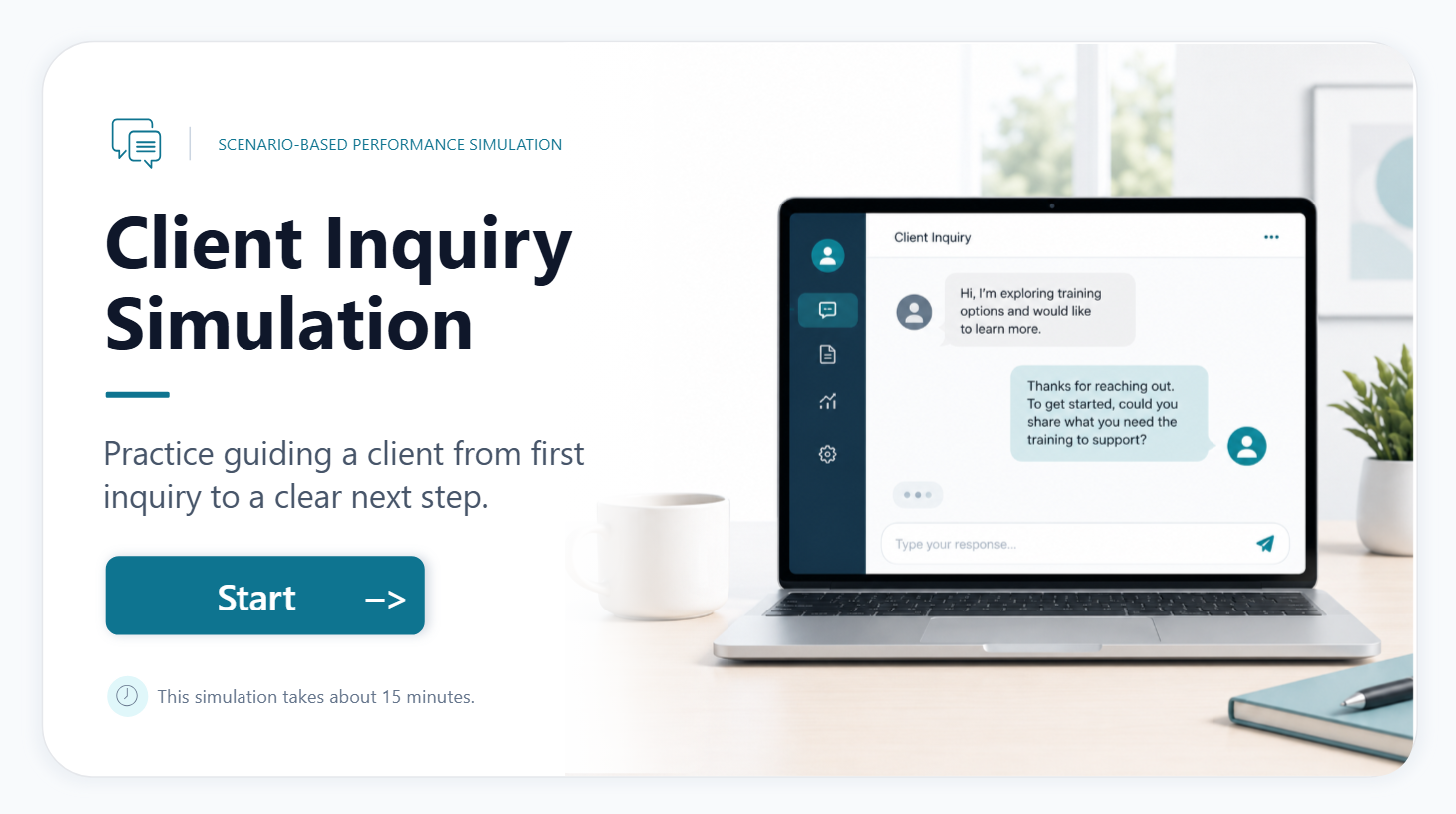
Client Inquiry Conversation Simulation
The Storyline prototype allows client-facing employees to practise guiding a realistic inquiry from initial contact toward a clear next step. Learners must understand the client’s needs, communicate relevant value, respond thoughtfully, and reflect on how each decision affects the conversation.
- Tool
- Articulate Storyline
- Format
- Scenario-based performance simulation
- Estimated duration
- 15 minutes
- Status
- Functional prototype in development
Development Evidence
Inside the Storyline Build
The prototype was developed in Articulate Storyline using slide triggers, timeline-based animations, object states, layers, motion paths, and conditional feedback. The authoring view demonstrates how the finished learner experience was constructed and controlled behind the scenes.
Interaction Logic
Triggers control navigation, animation, learner choices, and feedback behavior.
Visual States and Layers
States and slide layers support changing interface conditions without interrupting the scenario.
Guided Reflection
Coach Earl helps learners interpret the consequences of their choices rather than simply marking answers as correct or incorrect.
What the Learner Does
Responds to a realistic inquiry, gathers client needs, communicates value, handles concerns, and guides the conversation toward an appropriate next step.
What I Designed
The scenario structure, interface, response choices, coach guidance, feedback layers, interaction logic, animations, and visual system.
Why This Approach
Conversation skills require judgement and practice. A scenario-based simulation allows employees to test decisions safely and receive immediate, contextual feedback.
Project Context and Overview
This project explores a real-world sales performance challenge in a technical training services company. The organization receives inquiries from potential clients, but not all inquiries consistently convert into confirmed bookings or paying clients.
Instead of assuming that the issue can be solved through training alone, this project uses a diagnostic approach to determine whether the problem is caused by knowledge gaps, skill gaps, process gaps, motivation or accountability gaps, or market and offer-related gaps.
The final recommendation will include the right mix of learning solutions, performance support tools, workflow improvements, accountability measures, and evaluation methods.
The Challenge
I chose this project because it reflects a real challenge in technical training services: inquiries do not always turn into confirmed clients. At first glance, this can look like a sales team issue, but I wanted to avoid assuming that training was automatically the solution. For this case study, I approached the problem as both an instructional designer and performance consultant. My goal is to find out whether low or inconsistent client conversion is caused by a trainable gap, such as product knowledge or sales conversation skills, or by non-training factors, such as weak follow-up processes, unclear accountability, poor lead quality, pricing concerns, or unclear market positioning.
Key Diagnostic Question:
What is preventing client-facing employees from consistently converting potential clients into confirmed clients?
Diagnostic Approach
To keep the project focused, I used a five-category diagnostic framework. This helped me avoid jumping straight into course development and instead look at the wider performance system around client conversion. Each category represents a possible reason why conversion may be inconsistent. Some of these gaps can be solved through training, while others may require job aids, process improvements, clearer ownership, or better offer positioning.
Knowledge Gap
I checked whether employees understand the training services, program differences, inclusions, requirements, and value points.
Skill Gap
I looked at whether employees can ask needs-based questions, explain value, handle objections, and confirm next steps.
Process Gap
I reviewed whether there is a clear workflow for inquiry handling, lead tracking, proposal preparation, follow-up, documentation, and handoff.
Motivation / Accountability Gap
I examined whether lead ownership, response time expectations, sales targets, monitoring, feedback, and accountability are clearly defined.
Market / Offer Gap
I considered whether pricing, lead quality, competitor options, client budget, schedule availability, or unclear positioning affect conversion.
Desired Performance Flow
Before diagnosing the gaps, I first defined what effective sales and client engagement performance should look like. This gave the project a clear standard for comparing actual performance later.
Inquiry Response
Lead Qualification
Service Matching
Value Communication
Objection Handling
Proposal Support
Follow-Up
Closing / Lost Reason
This desired performance flow became the reference point for identifying whether the problem was related to knowledge, skill, process, accountability, or market or offer factors.
Selected Artifacts
To keep this portfolio case study focused, I am presenting the artifacts that best show my analysis process, design decisions, and performance support strategy. These outputs are meant to show how I moved from problem diagnosis to practical sales enablement recommendations.
Diagnostic Toolkit
CompletedA structured performance analysis tool used to identify whether sales conversion issues are caused by knowledge, skill, process, accountability, or market/offer gaps.
Includes: diagnostic framework, data collection plan, interview questions, observation checklist, lost inquiry review categories, gap classification, and solution mapping.
Gap Analysis Matrix
CompletedA structured analysis tool used to organize interview findings, classify root causes, determine whether training alone can solve the issue, and map each gap to the appropriate solution direction.
Includes: interview-based findings, gap categories, root causes, training decision checks, priority levels, and recommended solution directions.
Sales Enablement Solution Design
In developmentA design plan that outlines the recommended blend of learning activities, job aids, workflow support, accountability measures, and evaluation methods.
Sales Playbook / Job Aid
In developmentA practical performance support tool for service comparison, client needs analysis, value messaging, objection handling, proposal support, and follow-up.
Storyline Conversation Simulation
Functional prototype in developmentA scenario-based prototype where client-facing employees practise responding to inquiries, identifying client needs, communicating value, handling concerns, and confirming appropriate next steps through guided decisions and contextual feedback.
Evaluation Plan
PlannedA KPI-based plan for measuring response time, follow-up completion, proposal rate, conversion rate, sales conversation quality, and lost reason documentation.
Reflection
This project is helping me practice instructional design as performance consulting. Instead of starting with the assumption that a course is the answer, I am first defining the business problem, identifying the desired performance, and designing tools to diagnose the real causes of low or inconsistent client conversion.
For me, the value of this project is that it connects learning design to workplace performance. It allows me to demonstrate not only course development, but also problem analysis, root cause thinking, training versus non-training decision-making, job aid design, and evaluation planning.
This case study also reflects the kind of work I want to keep building: practical learning solutions that are grounded in real business problems and supported by clear evidence.
© 2026 Ken Gilmer P. Macawili. Instructional Design and HSEQ Training Portfolio.